
Search engines are the primary way people discover websites online. Whether you run a business website, blog, or portfolio, your visibility depends on how well search engines can understand your site. To do that, search engines follow a structured process known as crawling, rendering, and indexing.
Many website owners focus only on keywords and content while ignoring how search engines technically access their pages. This often leads to ranking issues even when the content is good. As an SEO analyst, I have seen many websites struggle simply because search engines could not properly crawl or render them.
Let’s explore how search engines crawl, render, and index your website using clear and simple language. This will help you understand how SEO really works behind the scenes and how to avoid common technical mistakes.
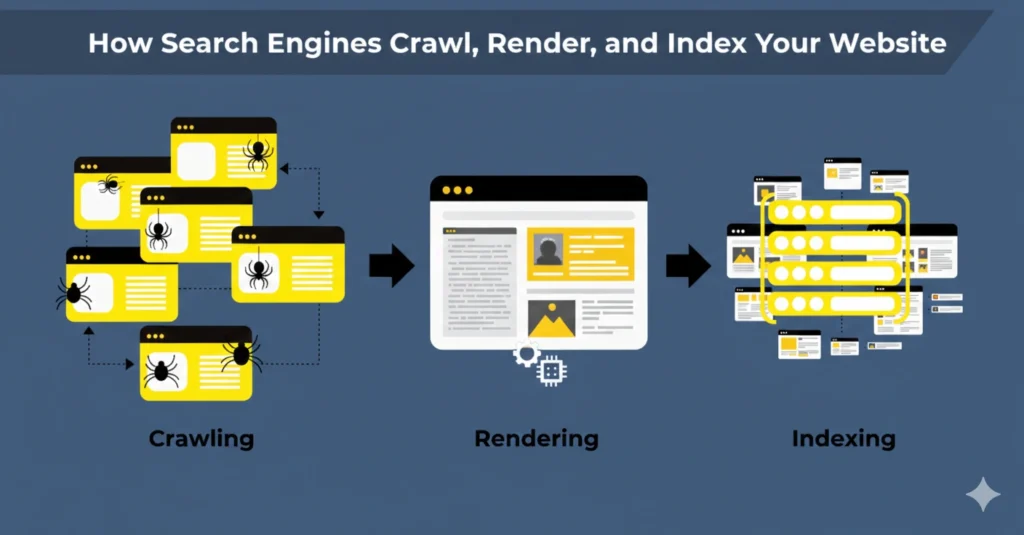
What Are Search Engines and Why Crawling, Rendering, and Indexing Matter
Search engines like Google, Bing, and others aim to provide users with the most relevant, trustworthy, and useful results. To do this, they must first discover, understand, and store information from websites.
This process happens in three main stages:
- Crawling – Discovering pages on the web
- Rendering – Processing how the page actually looks and behaves
- Indexing – Storing and organizing the page so it can appear in search results
If any of these stages fail, your website’s visibility can be reduced or completely blocked.
Stage 1: Crawling – How Search Engines Discover Your Website
What Is Crawling?
Crawling is the process where search engines send automated programs, commonly called bots or spiders, to find pages on the internet. Google’s crawler is known as Googlebot.
These bots move from page to page by following links, similar to how a human clicks links while browsing.
How Search Engines Find Pages
Search engines discover pages through several methods:
- Internal links within your website
- External links from other websites
- XML sitemaps submitted via Google Search Console
- Direct URL submissions
- Previously indexed URLs that are re-crawled
A well-structured website with clear internal linking makes it easier for search engines to crawl efficiently.
Crawl Budget and Why It Matters
Search engines do not crawl every page endlessly. Each website is given a crawl budget, which is the number of pages a search engine will crawl within a certain time.
Crawl budget is influenced by:
- Website authority and trust
- Server performance and speed
- Number of low-value or duplicate pages
- Proper use of robots.txt and no-index tags
Large or poorly structured websites often waste crawl budgets on unnecessary URLs, preventing important pages from being crawled.
Robots.txt and Crawl Control
What Is robots.txt?
The robots.txt file tells search engines which parts of your website they are allowed or not allowed to crawl.
For example, you might block:
- Admin pages
- Internal search result pages
- Staging or test environments
However, blocking important pages by mistake can prevent them from appearing in search results entirely.
Common Crawling Issues
Some common crawling problems include:
- Broken internal links
- Infinite URL parameters
- Incorrect robots.txt rules
- Server errors (5xx issues)
- Slow page load times
Regular technical SEO audits help identify and fix these issues before they impact performance.
Stage 2: Rendering – How Search Engines See Your Website
What Is Rendering?
Rendering is the process where search engines load and process the page, including:
- HTML structure
- CSS styling
- JavaScript functionality
- Images and media
This step helps search engines understand what users actually see on the page.
Why Rendering Is Important for Modern Websites
Many modern websites rely heavily on JavaScript frameworks such as React, Angular, or Vue. While these tools improve user experience, they can cause SEO issues if not implemented correctly.
If critical content only appears after JavaScript execution, search engines may:
- Delay indexing
- Miss important content
- Misinterpret page layout
Google can render JavaScript, but it requires additional resources and time.
JavaScript SEO Best Practices
To ensure proper rendering:
- Use server-side rendering (SSR) or static rendering where possible
- Ensure important content is visible in the initial HTML
- Avoid blocking JavaScript and CSS files
- Test pages using Google’s URL Inspection Tool
A website that renders cleanly for search engines is more likely to be indexed accurately.
Mobile Rendering and Mobile-First Indexing
Google uses mobile-first indexing, meaning it primarily evaluates the mobile version of your website.
This makes it essential that:
- Mobile and desktop content are equivalent
- Navigation works properly on mobile
- Text is readable without zooming
- Page speed is optimized
If your mobile site is incomplete or poorly rendered, your rankings may suffer, even for desktop searches.
Stage 3: Indexing – How Search Engines Store and Organize Your Pages
What Is Indexing?
Indexing is the process where search engines store and organize your content in a massive database known as the search index.
Only indexed pages are eligible to appear in search results.
How Search Engines Decide What to Index
Not every crawled page gets indexed. Search engines evaluate:
- Content quality and originality
- Relevance to search intent
- Page structure and clarity
- Internal linking importance
- Duplicate content signals
- Trust and authority of the domain
Low-value or thin pages may be crawled but excluded from the index.
Common Indexing Issues
Some frequent indexing problems include:
- Duplicate pages with no canonical tags
- Thin or autogenerated content
- Incorrect use of noindex tags
- Soft 404 pages
- Parameter-based URLs
Using Google Search Console regularly helps monitor which pages are indexed and why others are excluded.
The Role of Canonical Tags
Canonical tags tell search engines which version of a page is the preferred version.
They help prevent:
- Duplicate content confusion
- Index bloat
- Ranking dilution
Correct canonical implementation ensures search engines index the right pages and assign authority correctly.
How Content Quality Impacts Crawling and Indexing
Search engines prioritize content that demonstrates experience, expertise, authority, and trustworthiness (E-E-A-T).
High-quality content:
- Answers real user questions
- Is written clearly and accurately
- Is supported by expertise or experience
- Is updated regularly
Poor-quality content may still be crawled, but it is less likely to be indexed or ranked.
Internal Linking and Index Priority
Internal links signal importance. Pages that receive more internal links are:
- Crawled more frequently
- Considered more valuable
- Indexed faster
A logical site structure with clear navigation helps search engines understand your website hierarchy.
How Crawling, Rendering, and Indexing Affect Rankings
While crawling, rendering, and indexing do not directly determine rankings, they are prerequisites for ranking.
A page that:
- Cannot be crawled → cannot be indexed
- Cannot be rendered → may be misunderstood
- Is not indexed → cannot rank
Strong SEO performance depends on all three stages working correctly together.
Tools to Monitor Crawling, Rendering, and Indexing
Professional SEO analysts rely on tools such as:
- Google Search Console
- Screaming Frog
- Sitebulb
- PageSpeed Insights
- Log file analysis tools
These tools provide insights into how search engines interact with your website and where improvements are needed.
Best Practices Summary
To ensure your website is crawlable, renderable, and indexable:
- Maintain a clean site structure
- Use XML sitemaps correctly
- Optimize internal linking
- Avoid blocking important resources
- Ensure mobile-friendly design
- Publish high-quality, original content
- Monitor performance regularly
Consistent technical health supports long-term SEO growth.
Final Thoughts
Understanding how search engines crawl, render, and index your website is not optional, it is foundational. SEO is not just about keywords or links; it is about making your website accessible, understandable, and trustworthy.
By aligning technical SEO with high-quality content and user-focused design, you create a website that search engines can confidently recommend to users.
When crawling, rendering, and indexing work smoothly together, your website is positioned for stronger visibility, better rankings, and sustainable organic growth.
Want to make sure search engines can fully crawl, render, and index your site? Contact me for a technical SEO audit.