A high-converting website is not built by chance. Behind every successful website that turns visitors into customers is a carefully planned user experience (UX) design strategy. UX design focuses on how users interact with a website, how easily they find information, and how confident they feel taking action.
Users expect websites to be fast, intuitive, visually clear, and trustworthy. If a website feels confusing, slow, or overwhelming, users leave within seconds. This behaviour directly impacts conversion rates, search performance, and overall business growth.
This article explains the core UX design principles that every high-converting website follows, why they matter, and how they support both user satisfaction and SEO performance. The goal is to help you understand UX from a practical, results-driven perspective.
What Is UX Design and Why It Matters
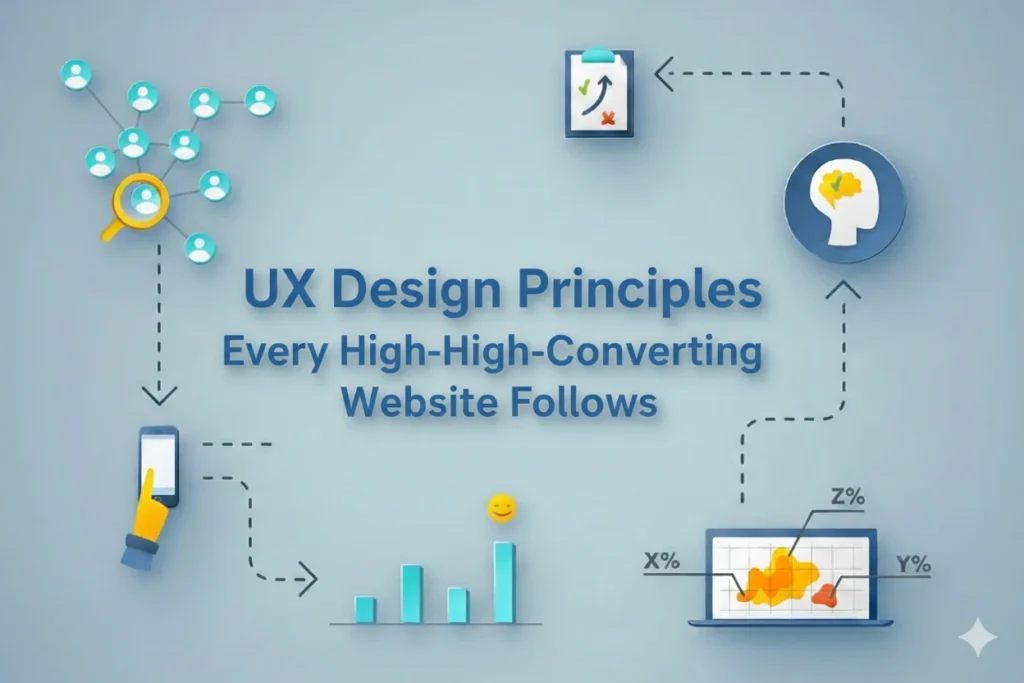
UX design refers to the overall experience a user has when interacting with a website. It covers usability, accessibility, design clarity, navigation, content structure, and emotional response.
From a business and SEO standpoint, UX design is critical because it directly influences:
- Bounce rates
- Time spent on site
- Conversion rates
- User trust and credibility
- Search engine rankings
Google increasingly rewards websites that provide a positive user experience. Pages that are easy to use, helpful, and engaging tend to perform better in search results because they align with Google’s goal of serving the best possible content to users.
UX Design and Google E-E-A-T
Google’s E-E-A-T framework evaluates content based on Experience, Expertise, Authoritativeness, and Trustworthiness. UX design supports these signals in several ways:
- Clear navigation reflects professionalism and expertise
- Transparent layouts improve trust
- Helpful content placement demonstrates experience
- Accessible design supports credibility and inclusivity
A website that feels reliable and easy to use naturally builds user confidence, which reinforces E-E-A-T principles.
Principle 1: Clarity Over Creativity
High-converting websites prioritise clarity above visual experimentation. While creativity has its place, users should never have to guess what a website offers or what action they should take next.
Why Clarity Matters
Users scan websites quickly. They want immediate answers to three questions:
- What is this website about?
- Is it relevant to my needs?
- What should I do next?
Clear headings, simple language, and obvious calls to action help users move forward without hesitation.
How to Apply This Principle
- Use plain, professional language
- Avoid unnecessary jargon
- Make primary actions visually prominent
- Keep layouts clean and uncluttered
Clarity reduces friction, which directly improves conversions.
Principle 2: User-Centred Navigation
Navigation is the backbone of UX design. If users cannot easily find what they are looking for, they will leave.
Characteristics of Effective Navigation
- Logical menu structure
- Clear labels that reflect user intent
- Consistent placement across pages
- Minimal depth (important pages should not be buried)
High-converting websites structure navigation based on user behaviour, not internal business terminology.
SEO and Navigation
Clear navigation improves crawlability for search engines and helps distribute internal link equity effectively, supporting stronger SEO performance.
Principle 3: Visual Hierarchy That Guides Attention
Visual hierarchy refers to how design elements are arranged to show importance. It helps users understand what to read first, second, and third.
Elements of Strong Visual Hierarchy
- Headings with clear size differences
- Strategic use of whitespace
- Consistent typography
- Clear contrast between sections
When users can easily scan content, they are more likely to stay engaged and take action.
Principle 4: Mobile-First and Responsive Design
Most users now access websites via mobile devices. A high-converting website must deliver an excellent experience across all screen sizes.
Key Mobile UX Considerations
- Readable text without zooming
- Touch-friendly buttons
- Fast-loading pages
- Simplified navigation
Google uses mobile-first indexing, meaning the mobile version of your site is the primary version evaluated for ranking.
A poor mobile experience negatively impacts both UX and SEO.
Principle 5: Page Speed and Performance Optimization
Speed is a fundamental UX principle. Users expect websites to load quickly, and even small delays can significantly reduce conversions.
Why Speed Matters
- Faster pages improve user satisfaction
- Slow websites increase bounce rates
- Page speed is a confirmed Google ranking factor
UX-Focused Speed Improvements
- Optimize images
- Reduce unnecessary scripts
- Use caching and performance plugins
- Choose reliable hosting
A fast website signals professionalism and trust.
Principle 6: Trust Signals Built Into the Design
Trust is essential for conversions. Users must feel confident that a website is legitimate and reliable before taking action.
Common UX Trust Elements
- Clear contact information
- Testimonials and reviews
- Secure payment indicators
- About and author information
- Consistent branding
These elements reassure users and support Google’s Trustworthiness evaluation.
Principle 7: Clear and Compelling Calls to Action (CTAs)
Every high-converting website guides users toward a specific action. CTAs should be clear, visible, and action-oriented.
Effective CTA Characteristics
- Specific and benefit-driven wording
- Contrasting design for visibility
- Logical placement within the content flow
- Consistent messaging
Instead of generic phrases, high-performing CTAs tell users exactly what will happen next.
Principle 8: Content Readability and Scannability
Users do not read websites word by word. They scan. UX design must support this behaviour.
Readability Best Practices
- Short paragraphs
- Clear subheadings
- Bullet points where appropriate
- Adequate line spacing
Readable content improves engagement, comprehension, and conversion rates while also supporting SEO.
Principle 9: Accessibility for All Users
Accessibility is both a UX and trust factor. A website should be usable by people with different abilities.
Accessibility UX Elements
- Proper colour contrast
- Readable font sizes
- Keyboard navigation support
- Clear labels and structure
Accessible design improves usability for everyone and demonstrates social responsibility and professionalism.
Principle 10: Consistency Across the Entire Website
Consistency builds familiarity and trust. High-converting websites maintain uniform design patterns, language, and layout throughout.
Areas That Require Consistency
- Fonts and colours
- Button styles
- Navigation structure
- Tone of voice
Inconsistent design creates confusion and reduces confidence.
How UX Design Supports Conversions and SEO Together
UX design and SEO are not separate disciplines. They work together to achieve the same goal: delivering value to users.
Strong UX leads to:
- Longer session durations
- Lower bounce rates
- Higher engagement
- Increased conversions
These behavioural signals indirectly support SEO performance and align with Google’s quality standards.
Common UX Mistakes That Reduce Conversions
Even well-designed websites can fail if they make these mistakes:
- Overloading pages with information
- Hiding key actions
- Ignoring mobile users
- Using unclear language
- Neglecting trust elements
Avoiding these issues is often more impactful than adding new features.
Final Thoughts
Every high-converting website follows the same foundational UX design principles: clarity, usability, trust, and consistency. These principles are not trends; they are proven practices grounded in user behaviour and search engine expectations.
When UX design is executed correctly, it enhances user satisfaction, supports Google’s E-E-A-T guidelines, and creates a website that not only attracts traffic but converts it into meaningful outcomes.
Whether you are building a new website or improving an existing one, focusing on UX design is one of the most effective investments you can make for long-term growth.
Ready to turn your website into a high-converting experience? Contact me today to optimize your UX and drive real business results.